

Short answer: Medellín is one of the strongest locations for a nearshore call center in Latin America because it combines Colombia's second-largest BPO talent pool, English proficiency above the national average, a stable time zone (UTC-5 year-round) that overlaps with US business hours, lower seismic risk than other regional hubs, and a tax framework that favors exported services. For US companies, it means bilingual teams working your hours at a fraction of onshore cost.
Last updated: October 2026.
A nearshore call center is a customer service, sales or support operation located in a nearby country with overlapping business hours and strong cultural affinity. For US companies, nearshoring usually means Latin America instead of offshore destinations in Asia.
The difference is practical. Manila is 12 to 13 hours ahead of US Eastern Time, and India is 9.5 to 10.5 hours ahead, so offshore teams often work overnight shifts and managers coordinate across opposite schedules. A nearshore team in Medellín works the same business day as your US team, which makes real-time supervision, training, escalations and site visits far easier. It also gives you native Spanish speakers to serve the large Spanish-speaking customer base in the US.

Medellín is Colombia's second BPO hub after Bogotá. According to the Colombian BPO Association (BPrO), Bogotá concentrates 50% of the sector's jobs, Medellín 22.9% and Barranquilla 8.8%. That scale matters: a labor market with deep contact center experience shortens recruiting timelines and the learning curve for every new program.
Beyond volume, the city offers three advantages that are hard to replicate: a university and technology ecosystem that feeds technical support and consultative sales profiles, a cost of living that keeps operations competitive, and a strong service culture. If you are evaluating a nearshore call center in Medellín, these factors translate directly into team stability and interaction quality.
The EF English Proficiency Index is the largest ranking of adult English skills worldwide. Here is the 2025 picture for the main countries and cities used for nearshore operations:
| Country or city | Score | EF level |
|---|---|---|
| Argentina | High | |
| Colombia: customer serviceProfessionals in the function | High | |
| Chile | Moderate | |
| MedellínCity | Moderate | |
| BogotáCity | Moderate | |
| Brazil | Low | |
| ColombiaNational average | Low | |
| Mexico | Very low |
Argentina has the region's strongest English, though dollar-based labor costs tend to be higher and the macroeconomic environment more volatile. Chile performs well with higher operating costs, Brazil's Portuguese-speaking workforce is a barrier for Spanish-language support, and Mexico ranks lowest in the group.
Colombia's national average hides the number that matters most for a call center: Medellín scores 516, and people working in customer service across the country score 570, a high level on EF's scale. The talent already working in the industry is well above the national average, which is what makes it possible to build bilingual teams at scale.
Choosing where to place a nearshore operation is about more than language. Time zone overlap, business continuity and operational risk matter just as much. Here is how the most common hubs compare, with Manila as an offshore reference:
| City | Time zone | Gap vs. US Eastern | Seismic hazard | Main language |
|---|---|---|---|---|
| Medellín, Colombia | UTC-5 | 0 to 1 hour | Intermediate | Spanish |
| Mexico City | UTC-6 | 1 to 2 hours | High1985 and 2017 earthquakes | Spanish |
| Santiago, Chile | UTC-4 / UTC-3 | 1 to 2 hours | Very high8.8 earthquake in 2010 | Spanish |
| Lima, Peru | UTC-5 | 0 to 1 hour | HighSubduction zone | Spanish |
| São Paulo, Brazil | UTC-3 | 1 to 2 hours | Low | Portuguese |
| Manila, PhilippinesOffshore reference | UTC+8 | 12 to 13 hours | High | English, Filipino |
Colombia does not observe daylight saving time, which keeps scheduling simple: Medellín matches US Eastern Time in winter, sits one hour behind it in summer, and matches US Central Time during daylight saving time.

In a call center, every minute of downtime is a direct cost. Colombia has international connectivity through multiple submarine cables and top-tier carriers, and its BPO sector works to enterprise security and continuity standards.
At Intelsa, for example, we design operations with concrete redundancies: dual internet providers with diverse fiber paths and 4G/5G failover, cloud telephony with multi-region redundancy, UPS and generator power backup, and a work-at-home model that can be activated as a contingency. These measures are defined in each client's service level agreement (SLA).
Colombia offers a favorable framework for companies buying services from abroad. These are the instruments that matter most:
| Instrument | Benefit | Key requirement | Status |
|---|---|---|---|
| Export of services | Colombian VAT exemption for services used exclusively abroad | Meet the requirements of Colombia's Tax Code | In force |
| Free trade zones | 20% income tax rate on export income, versus the 35% general rate | Internationalization plan filed with Colombia's Ministry of Commerce | In force |
| US-Colombia Trade Promotion Agreement | Free trade agreement that supports cross-border trade in services | Applies to trade between both countries | In force |
| Double tax treatiesCanada, Spain, UK, Mexico, Chile, among others | Avoid double taxation on service income | Relevant if you invoice from one of these countries | In force |
| US-Colombia income tax treaty | No comprehensive income tax treaty between both countries | Structure contracts with a tax advisor | None |
The real impact depends on your company's structure, where you invoice from and the type of service you contract, so we recommend reviewing it with a tax advisor before making a decision.
Choosing the right location is the first decision, but not the only one. These are the levers with the biggest impact on the total cost of a nearshore contact center operation:
Not every interaction requires an onshore agent. Tier 1 support, order taking, scheduling, collections and back office work can move to a nearshore team without changing the customer experience, while onshore staff focus on the most sensitive accounts.
Not every operation should be priced the same way. A dedicated agent (FTE) model gives you control and stability in customer service; hourly billing works well for programs with variable volume; and outcome-based or hybrid models align incentives in sales outsourcing and outbound telemarketing.
AI bots and agents resolve repetitive tier 1 inquiries while human agents focus on complex cases, sales and retention. AI also lowers costs through agent copilots and automated quality monitoring across 100% of interactions. See how we do it in AI Transformation.
Much of a call center's budget is lost to overstaffing or missed service levels from understaffing. Interval-level demand forecasting, multiskilled teams and blending inbound and outbound work increase productive occupancy without hurting the experience.
Structuring the contract correctly as an export of services can keep Colombian VAT off your invoices. It is a lever many companies overlook when they compare vendors on hourly rate alone.
Attrition is one of the biggest hidden costs in a contact center: every departure means recruiting, training and waiting for the new agent to reach full productivity. A mature labor market like Medellín's, clear career paths and good hiring from day one reduce that cost.
Before moving an entire operation, define a pilot with clear KPIs (service level, first contact resolution, CSAT, conversion or recovery rate, depending on the program) and a scale-up plan. That way the savings are proven with data, not assumptions.
Both cities are established hubs. Bogotá has the largest BPO workforce in the country and hosts many corporate headquarters. Medellín offers a large talent pool, a slightly higher English score (516 versus 513 on the EF EPI 2025) and a strong service culture. For operations that prioritize team stability and bilingual support, Medellín is a very competitive choice.
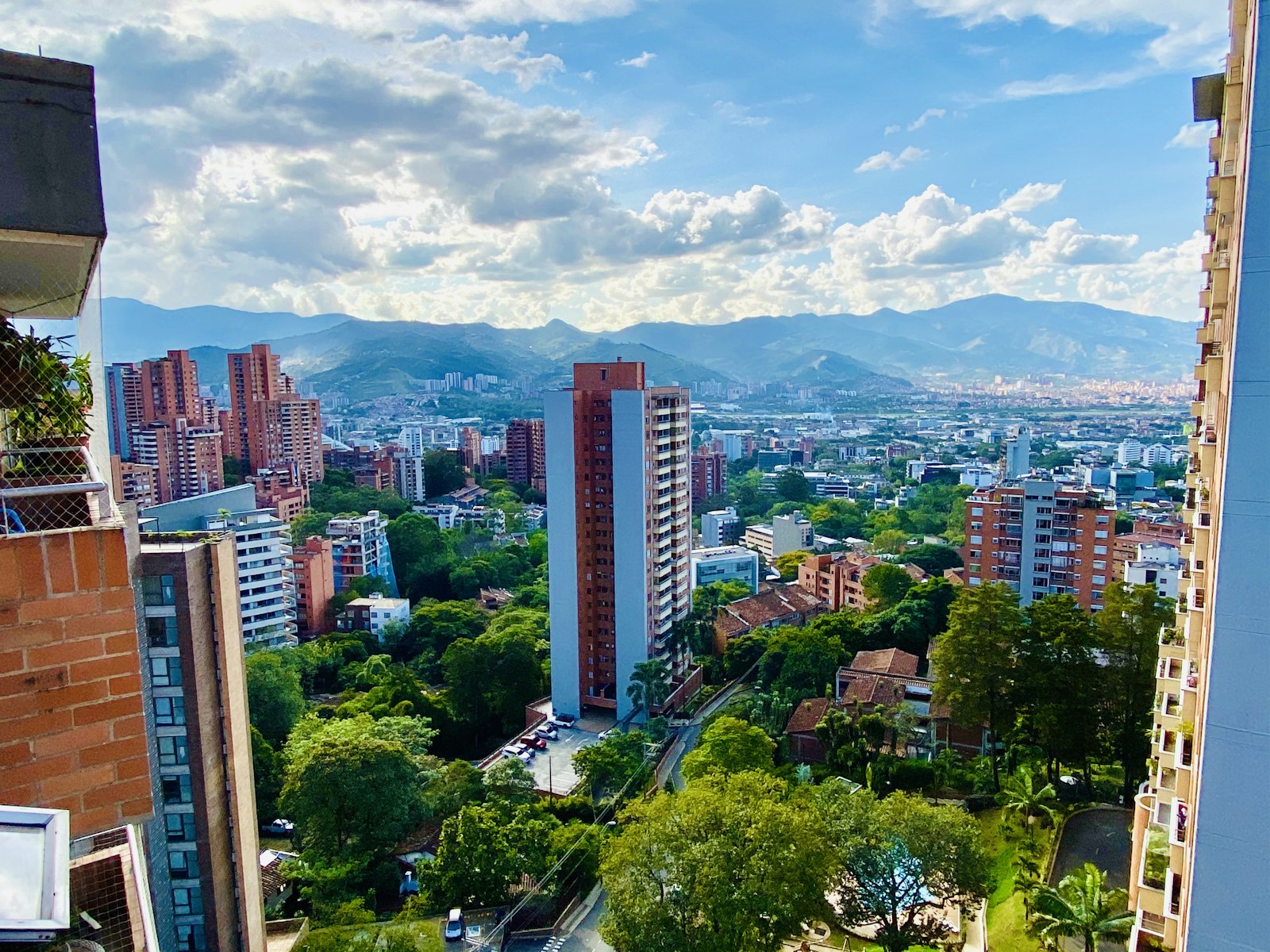
Yes. Colombia combines a large BPO workforce, neutral Spanish, English proficiency above the national average in its main hubs, a UTC-5 time zone aligned with US business hours and a tax framework that favors exported services. The United States is already the largest market for Colombia's BPO exports.
Cost depends on the pricing model (per agent, per hour or per outcome), language requirements, hours of operation, channels and specialization. In general, operating from Colombia is significantly less expensive than staffing the same operation in the United States at comparable quality. The most accurate way to know is to request a quote based on your real volumes and profiles.
Offshoring moves work to any lower-cost country regardless of distance or time zone, often Asia for US companies. Nearshoring prioritizes nearby countries with overlapping hours and cultural affinity, which makes supervision, travel and real-time collaboration easier.
Medellín scores 516 on the EF EPI 2025, above Colombia's national average, and customer service professionals across the country score 570. In practice, BPO providers test every agent's English before assigning them to a bilingual program.
Customer service, technical support, sales and telemarketing, lead management, collections, order taking, back office and bilingual support for the US market, among others. More and more programs combine human agents with automation and AI, as in our work with technology and SaaS companies.
Intelsa runs customer service, sales, collections and back office operations from Medellín for companies in the United States, Colombia and Latin America, combining bilingual talent with AI Workforce. If you are evaluating a nearshore call center in Latin America, talk to an expert and we will design a measurable pilot with you.